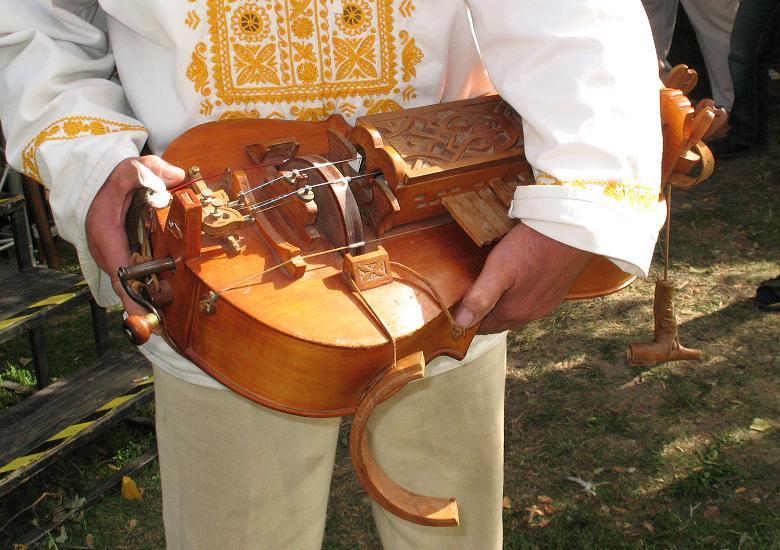
Shape
In her overview of the instrument's history, Palmer recorded twenty-three different forms, and there is still no standardized design today.
The six-stringed French vielle à roue is the best-known and most common sort. A number of regional forms developed, but outside France the instrument was considered a folk instrument and there were no schools of construction that could have determined a standard form.
There are two primary body styles for contemporary instruments: guitar-bodied and lute-backed. Both forms are found in French-speaking areas, while guitar-bodied instruments are the general form elsewhere. The box form of the simphonia is also commonly found among players of early music and historical re-enactors.
Strings
Historically, strings were made of gut, which is still a preferred material today and modern instruments are mounted with violin (D or A) and cello (A, G, C) strings. However, metal strings have become common in the twentieth century, especially for the heavier drone strings or for lower melody strings if octave tuning is used. Nylon is also sometimes used, but is disliked by many players. Some instruments also have optional sympathetic strings, generally guitar or banjo B strings.
The drone strings produce steady sounds at fixed pitches. The melody string(s) (French chanterelle(s), Hungarian dallamhúr(ok)) are stopped with tangents attached to keys that change the vibration length of the string, much as a guitarist uses his or her fingers on the fretboard of a guitar. In the earliest hurdy-gurdies these keys were arranged to provide a Pythagorean temperament, but in later instruments the tunings have varied widely, with equal temperament most common because it allows easier blending with other instruments. However, because the tangents can be adjusted to tune individual notes, it is possible to tune hurdy-gurdies to almost any temperament as needed. Most contemporary hurdy-gurdies have 24 keys that cover a range of two chromatic octaves.
To achieve proper intonation and sound quality, each string of a hurdy-gurdy must be wrapped with cotton or similar fibers. The cotton on melody strings tends to be quite light, while drone strings have heavier cotton. Improper cottoning results in a raspy tone, especially at higher pitches. In addition, individual strings (in particular the melody strings) often have to have their height above the wheel surface adjusted by having small pieces of paper placed between the strings and the bridge, a process called shimming. Shimming and cottoning are connected processes since either one can affect the geometry of the instrument's strings.
Buzzing bridge
In some types of hurdy-gurdy, notably the French vielle à roue ('fiddle with a wheel') and the Hungarian tekerőlant (tekerő for short), makers have added a buzzing bridge—called a chien (French for dog) or recsegő (Hungarian for "buzzer")—on one drone string. Modern makers have increased the number of buzzing bridges on French-style instruments to as many as four. This mechanism consists of a loose bridge under a drone string. The tail of the buzzing bridge is inserted into a narrow vertical slot (or held by a peg in Hungarian instruments) that holds the buzzing bridge in place (and also serves as a bridge for additional drone strings on some instruments).
The free end of the dog (called the hammer) rests on the soundboard of the hurdy-gurdy and is more or less free to vibrate. When the wheel is turned regularly and not too fast the pressure on the string (called the trompette on French instruments) holds the bridge in place, sounding a drone. When the crank is struck, the hammer lifts up suddenly and vibrates against the soundboard, producing a characteristic rhythmic buzz that is used as an articulation or to provide percussive effect, especially in dance pieces.
On French-style instruments, the sensitivity of the buzzing bridge can be altered by turning a peg called a tirant in the tailpiece of the instrument that is connected by a wire or thread to the trompette. The tirant adjusts the lateral pressure on the trompette and thereby sets the sensitivity of the buzzing bridge to changes in wheel velocity. When hard to trigger, the strike or the bridge is said "sec" (dry), "chien sec" or "coup sec". When easy to trigger, the strike or the bridge is said "gras" (fat), "chien gras", or "coup gras".
There are various stylistic techniques that are used as the player turns the crank, striking the wheel at various points in its revolution. This technique is often known by its French term, the coup-de-poignet (or, more simply, the shortened coup). The percussion is transmitted to the wheel by striking the handle with the thumb, fingers or base of the thumb at one or more of four points in the revolution of the wheel (often described in terms of the clock face, 12, 3, 6 and 9 o'clock) to achieve the desired rhythm. A long buzz can also be achieved by accelerating the wheel with the handle. It is called either "un glissé" (a slide) or "une trainée" (a streak).
On the Hungarian tekerő the same control is achieved by using a wedge called the recsegőék (control wedge, or literally "buzzer wedge") that pushes the drone string downward. In traditional tekerő playing, the buzzing bridge is controlled entirely by the wrist of the player and has a very different sound and rhythmic possibilities from those available on French instruments.
Regional Types
Regional types of hurdy-gurdies since the Renaissance can also be classified based on wheel size and the presence or absence (and type) of a buzzing bridge. The following description of various types uses this framework:
Small Wheel
Small-wheeled (wheel diameter less than 14 cm, or about 5.5 inches) instruments are traditionally found in Central and Eastern Europe. They feature a broad keybox and the drone strings run within the keybox. Because of the small size of the wheel these instruments most commonly have three strings: one melody string, one tenor drone and one bass drone. They sometimes have up to five strings.
Large Wheel
Large-wheeled instruments (wheel diameters between 14 and 17 cm, or about 5.5 – 6.6 inches) are traditionally found in Western Europe. These instruments generally have a narrow keybox with drone strings that run outside the keybox. They also generally have more strings and doubling or tripling of the melody string is common. Some modern instruments have as many as fifteen strings played by the wheel, although the most common number is six.