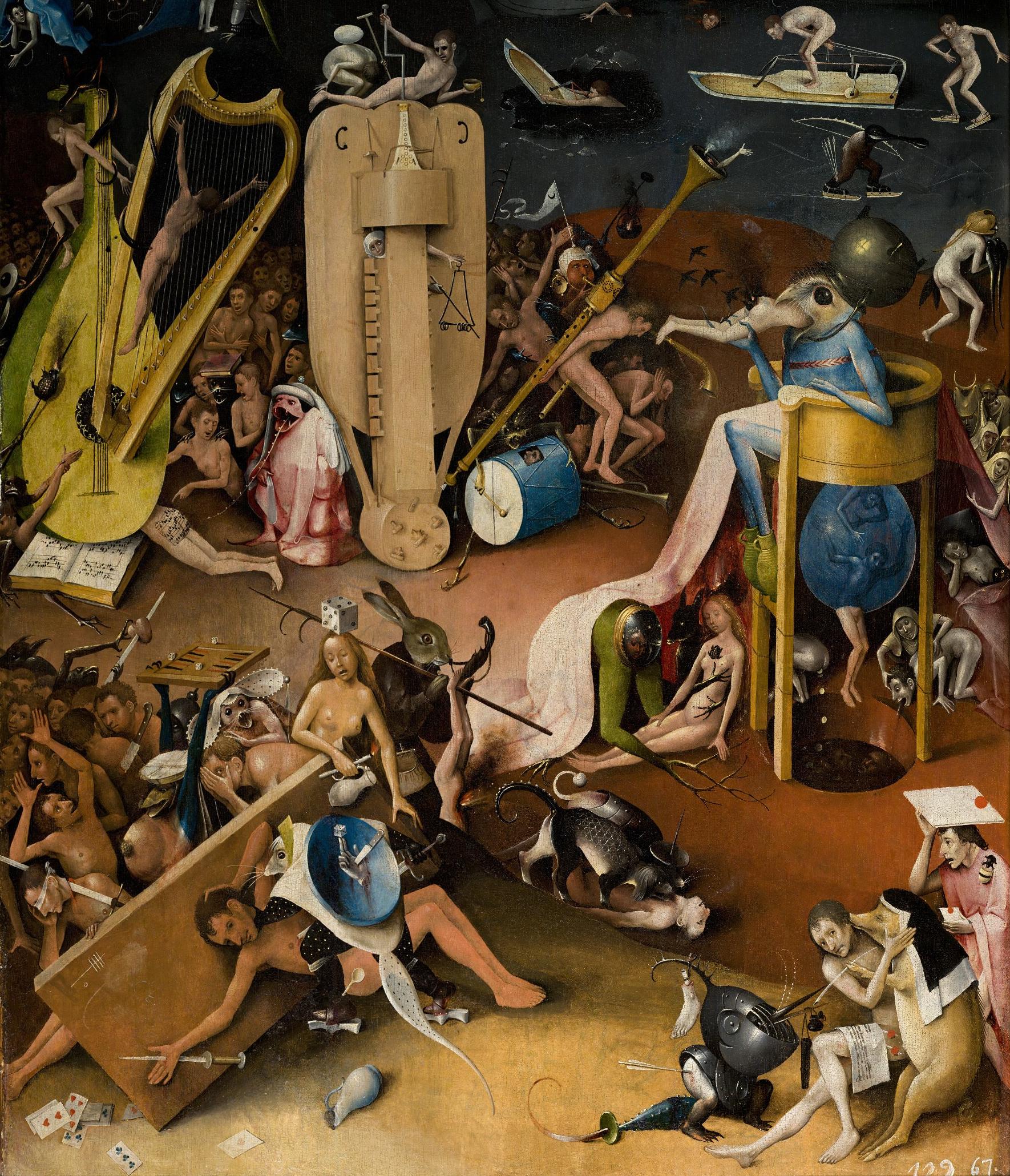
The hurdy-gurdy is generally thought to have originated from fiddles in either Europe or the Middle East (e.g., the rebab instrument) some time before the eleventh century A.D. The first recorded reference to fiddles in Europe was in the 9th century by the Persian geographer Ibn Khurradadhbih (d. 911) describing the lira (lūrā) as a typical instrument within the Byzantine Empire. One of the earliest forms of the hurdy-gurdy was the organistrum, a large instrument with a guitar-shaped body and a long neck in which the keys were set (covering one diatonic octave). The organistrum had a single melody string and two drone strings, which ran over a common bridge, and a relatively small wheel. Due to its size, the organistrum was played by two people, one of whom turned the crank while the other pulled the keys upward. Pulling keys upward is cumbersome, so only slow tunes could be played on the organistrum.
The pitches on the organistrum were set according to Pythagorean temperament and the instrument was primarily used in monastic and church settings to accompany choral music. Abbot Odo of Cluny (died 942) is supposed to have written a short description of the construction of the organistrum entitled Quomodo organistrum construatur (How the Organistrum Is Made), known through a much later copy, but its authenticity is very doubtful. Another 10th-century treatise thought to have mentioned an instrument like a hurdy-gurdy is an Arabic musical compendium written by Al Zirikli. One of the earliest visual depictions of the organistrum is from the twelfth-century Pórtico da Gloria (Portal of Glory) on the cathedral at Santiago de Compostela, Galicia, Spain: it has a carving of two musicians playing an organistrum.
Later on, the organistrum was made smaller to let a single player both turn the crank and work the keys. The solo organistrum was known from Spain and France, but was largely replaced by the symphonia, a small box-shaped version of the hurdy-gurdy with three strings and a diatonic keyboard. At about the same time, a new form of key pressed from beneath was developed. These keys were much more practical for faster music and easier to handle; eventually they completely replaced keys pulled up from above. Medieval depictions of the symphonia show both types of keys.
During the Renaissance, the hurdy-gurdy was a very popular instrument (along with the bagpipe) and the characteristic form had a short neck and a boxy body with a curved tail end. It was around this time that buzzing bridges first appeared in illustrations. The buzzing bridge (commonly called the dog) is an asymmetrical bridge that rests under a drone string on the sound board. When the wheel is accelerated, one foot of the bridge lifts from the soundboard and vibrates, creating a buzzing sound. The buzzing bridge is thought to have been borrowed from the tromba marina (monochord), a bowed string instrument.
During the late Renaissance, two characteristic shapes of hurdy-gurdies developed. The first was guitar-shaped and the second had a rounded lute-type body made of staves. The lute-like body is especially characteristic of French instruments.
By the end of the 17th century changing musical tastes demanded greater polyphonic capabilities than the hurdy-gurdy could offer and pushed the instrument to the lowest social classes; as a result it acquired names like the German Bauernleier 'peasant's lyre' and Bettlerleier 'beggar's lyre'. During the 18th century, however, French Rococo tastes for rustic diversions brought the hurdy-gurdy back to the attention of the upper classes, where it acquired tremendous popularity among the nobility, with famous composers writing works for the hurdy-gurdy. The most famous of these is Nicolas Chédeville's Il pastor Fido, attributed to Vivaldi. At this time the most common style of hurdy-gurdy developed, the six-string vielle à roue. This instrument has two melody strings and four drones. The drone strings are tuned so that by turning them on or off, the instrument can be played in multiple keys.
During this time the hurdy-gurdy also spread further to Central Europe, where further variations developed in western Slavic countries, German-speaking areas and Hungary (see the list of types below for more information on them). Most types of hurdy-gurdy were essentially extinct by the early twentieth century, but a few have survived. The best-known are the French vielle à roue, the Hungarian tekerőlant, and the Spanish zanfoña. In Ukraine, a variety called the lira was widely used by blind street musicians, most of whom were purged by Stalin in the 1930s.
The hurdy-gurdy tradition is well-developed particularly in Hungary, Poland, Belarus and Ukraine. In Ukraine, it is known as the lira or relia. It was and still is played by professional, often blind, itinerant musicians known as lirnyky. Their repertoire has mostly para-religious themes. Most of it originated in the Baroque period. In Eastern Ukraine, the repertoire includes unique historic epics known as dumy and folk dances.
Lirnyky were categorised as beggars by the Russian authorities and fell under harsh repressive measures if they were caught performing in the streets of major cities until 1902, when the authorities were asked by ethnographers attending the 12th All-Russian Archaeological conference to stop persecuting them.
The hurdy-gurdy is the instrument played by Der Leiermann, the street musician portrayed in the last, melancholy song of Schubert's Winterreise. It is also featured and played prominently in the film Captains Courageous (1937) as the instrument of the character Manuel, acted by Spencer Tracy.
The instrument came into a new public consciousness when Donovan released his hit pop song, "Hurdy Gurdy Man", in 1968. Although the song does not use a hurdy-gurdy, the repeated reference to the instrument in the song's lyrics sparked curiosity and interest among young people, eventually resulting in an annual hurdy-gurdy music festival in the Olympic Peninsula area of the state of Washington each September.
Today, the tradition has resurfaced. Revivals have been underway for many years as well in Austria, Belarus, Belgium, the Czech Republic, Germany, Italy, the Netherlands, Poland, Portugal, Russia, Slovakia, Spain, Sweden and Ukraine. As the instrument has been revived, musicians have used it in a variety of styles of music, including contemporary forms not typically associated with it.